
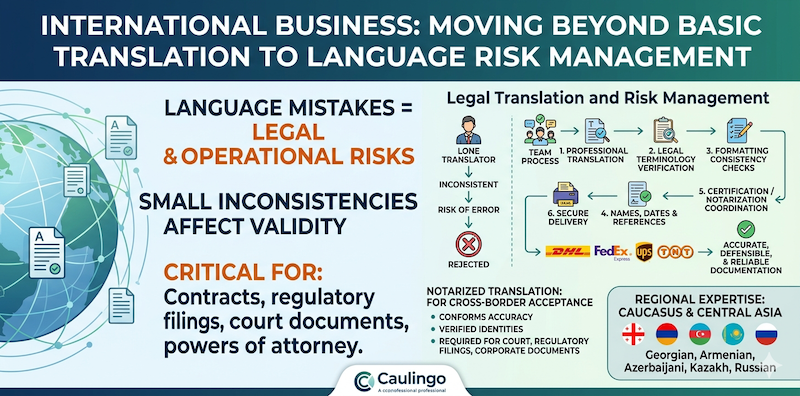
In international business, language mistakes are not just communication issues - they are legal and operational risks.
Contracts, regulatory filings, court documents, corporate records, and powers of attorney frequently move across languages and jurisdictions. If these documents are translated incorrectly or inconsistently, the consequences can be serious: rejected filings, contract disputes, regulatory delays, or reputational damage.
Even small inconsistencies - such as a misspelled name, incorrect date, or poorly translated legal term - can affect how a receiving institution reviews or processes a document.
For this reason, organizations operating internationally increasingly move beyond basic translation toward language risk management.
Why Legal Translation Requires Absolute Precision
Legal and compliance documents rely on exact terminology and structural consistency. A single mistranslation can change the legal meaning of a clause or introduce ambiguity into a contract.
When documents cross borders, they must preserve:
- legal intent and terminology
- formatting and structural consistency
- accuracy of names, dates, and references
- compliance with procedural requirements
Without careful verification, translation errors can lead to rejected documentation, compliance issues, or legal vulnerabilities.
For international companies, translation must therefore be treated as a controlled process, not just a one-off linguistic task.
Moving From Translation to Language Risk Management
In practice, sensitive documentation is handled through a structured language risk management approach.
Instead of focusing only on translation, we support a structured linguistic workflow for high-risk documents, including terminology, formatting, and consistency checks.
Our workflow typically includes:
- professional translation where required
- legal terminology verification
- formatting and numbering consistency checks
- verification of names, dates, and references
- certification or notarization coordination
- secure document scanning and record keeping
- delivery of original documents domestically and internationally through trusted courier partners such as DHL, FedEx, UPS, and TNT
This structured approach can support clear, consistent multilingual documentation and reduce avoidable linguistic and operational errors.
Notarized Translation for Cross-Border Documentation
For cross-border documents, translation may be only one part of the process. Requirements for certification, notarization, apostille, legalization, and translation vary by jurisdiction and by the institution receiving the document.
Where notarization is required, a notary may authenticate a signature or declaration under the procedure applicable in that jurisdiction. This is distinct from assessing the translation itself or deciding whether a receiving institution will accept a document.
Depending on the document type and intended use, receiving institutions may request items such as a translation, a translator’s declaration, notarization, apostille, legalization, or another form of document authentication.
Clients should confirm the exact requirements with the relevant authority, court, institution, or adviser before proceeding. We can help prepare translations and coordinate the requested documentation steps where appropriate.
Regional Expertise in the Caucasus and Central Asia
Legal translation often requires more than linguistic knowledge. It also demands familiarity with local administrative and legal procedures.
Multilingual documentation in the region can involve:
- Georgian
- Armenian
- Azerbaijani
- Kazakh
- Russian
For documents used across multiple jurisdictions, requirements should be confirmed with the receiving institution or relevant authority before translation, certification, notarization, apostille, or legalization is arranged.
When Documentation Carries Legal Risk
In high-stakes environments, translation is not simply a linguistic service. It is a risk management function.
Organizations must ensure that multilingual documentation can withstand scrutiny from regulators, courts, business partners, and auditors.
Language risk management provides the processes needed to protect documentation integrity and reduce operational risk.
Because when legal documents cross borders, precision matters.
FAQ
What is a notarized translation?
The term “notarized translation” can describe different procedures in different jurisdictions. It may involve a translator’s declaration and notarization of that declaration or signature; the precise process and effect should be confirmed with the receiving institution or relevant authority.
What is a sworn translation?
A sworn or officially authorized translator is recognised under specific national or local systems. The required form, scope, and acceptance of such a translation vary by jurisdiction and intended use.
What is the difference between sworn and notarized translation?
They are distinct concepts. A sworn translation concerns the status or authorization of a translator within a particular legal system. Notarization generally concerns a signature, declaration, or other act performed by a notary. Neither term alone establishes universal acceptance.
Before proceeding, clients should confirm whether the receiving institution requires a translation, a translator’s declaration, notarization, apostille, legalization, or another document-authentication step.
How does certification work in the Caucasus and Central Asia?
Procedures in the Caucasus and Central Asia vary by jurisdiction, document type, and receiving institution. A request for a translation may be accompanied by requirements for a translator’s declaration, notarization, apostille, legalization, or another form of authentication.
Requirements can also differ according to the source country, destination country, and intended use. Clients should confirm the relevant procedure directly with the institution or authority receiving the document.
Do courts accept translated documents?
Court requirements for translated documents vary by jurisdiction, court, case type, document type, and procedural stage.
Before submitting a translated document, confirm with the relevant court, authority, or qualified adviser whether it requires a particular translation format, translator declaration, certification, notarization, apostille, legalization, or another supporting document.
Professional legal translation can help prepare clear, consistent translations for the requirements identified by the receiving court or authority. Learn more about our notarized translation service.